
If you are building an app, an automation, or an AI agent that needs to publish to social media, you have two options: integrate each platform's API separately (and babysit every OAuth flow, media spec, and breaking change) — or use one scheduling API that does it for you.
This guide compares the leading social media scheduling APIs as of September 2026. One thing has changed fast this year: MCP servers are now table stakes. Nearly every serious scheduling API can plug into Claude, ChatGPT, Cursor, or a custom agent — so the real differences have shifted to platform coverage, pricing models, queue behavior, and whether the tool can create content or only ship it.
What actually matters in a scheduling API
- Platform coverage. TikTok, Instagram, Pinterest, LinkedIn, Threads, Facebook, YouTube, and X are the core eight for consumer reach. Some APIs go broader (Reddit, Bluesky, Discord, Telegram, even ad networks) — count the ones you'll actually use.
- Hosted queue vs. fire-at-time. A hosted queue stores scheduled posts and fires them server-side with retries. A bare publish endpoint means you build the scheduler and the failure alerts.
- MCP quality, not just MCP existence. Most tools now have an MCP server. The question is what the agent can actually do through it — schedule, verify results, handle media — and whether the content it posts has to come from somewhere else.
- Media handling. TikTok and Instagram process video asynchronously. Good APIs poll the platform and reconcile final status for you; bad ones return "accepted" and go silent.
- Pricing model fit. Per-account, per-post, per-organization, and flat tiers all exist — the same usage can differ by an order of magnitude between models, so model your own numbers.
- Content, not just plumbing. Almost every scheduling API assumes you already have the post. If you also need the content generated, a combined tool removes a whole second vendor.
1. ViralFarm — best for content + scheduling in one, via app or AI agent
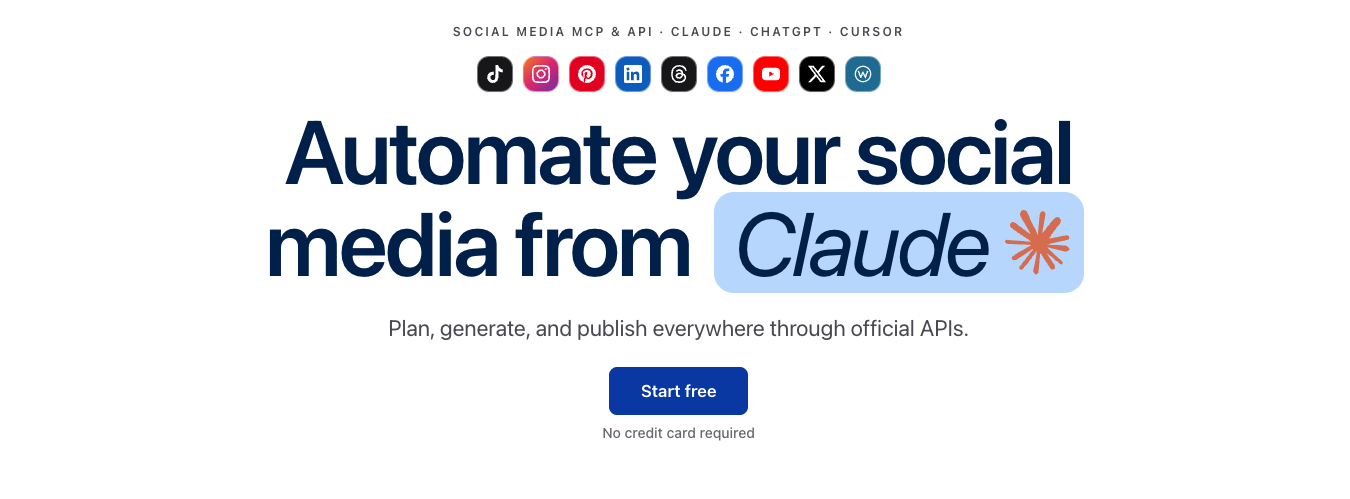
ViralFarm is a unified API + MCP server that posts and schedules across the eight major consumer platforms: TikTok, Instagram, Pinterest, LinkedIn, Threads, Facebook, YouTube, and X. Connect the MCP server to Claude, ChatGPT, Cursor, or any MCP-compatible agent and it can list your accounts, schedule posts, and confirm what went out.
ViralFarm also generates the content — something almost nothing else on this list does. It has templates for carousels, Pinterest pins and short videos that your agent can generate posts from, with no limit on generations — so an agent can go from "promote this blog post" to published content in one conversation, without a separate content tool in the stack. And because there's a full scheduling app on top of the API, non-developers on your team work from the same queue.
Scheduling runs on a hosted queue with per-platform result tracking, automatic retries with backoff, and async status reconciliation for TikTok and Instagram video processing.
- Pros: generates viral-format content and publishes it; all 8 core platforms; native MCP server; hosted queue with retries; full web app included; free to start.
- Cons: newer than the incumbents; focused on the core consumer platforms rather than long-tail networks like Reddit or Discord.
Wiring up an agent this week? The free tier and its API limits are on the ViralFarm API + MCP page.
2. Ayrshare — best established, broadest enterprise option
Ayrshare is one of the longest-running social posting APIs and it has kept pace: 14+ networks (including Bluesky, Reddit, Telegram, Snapchat, Google Business Profile, and WhatsApp in beta), SDKs for Node.js, Python, and Go, a CLI, and a native MCP server aimed at agent frameworks like LangChain, CrewAI, and AutoGen as well as Claude and Cursor. It advertises 99.99%+ uptime and tens of millions of daily API calls.
- Pros: mature, well-documented, broad platform list; native MCP server; volume pricing for large deployments.
- Cons: no content generation; pricing is tier/contact-sales shaped at scale, so model your costs carefully.
3. Postiz — best open-source / self-hosted option
Postiz is an open-source scheduler (self-hostable from its public GitHub repo) that has grown into a full product: 30+ networks including Discord, Slack, Bluesky, and Reddit, a REST API on every paid plan, webhooks, and an AI-agents CLI plus MCP support for Claude, ChatGPT, Cursor, and others. Hosted plans run $29–$99/month across four tiers, with a 7-day trial.
- Pros: open source and self-hostable; very broad network list; MCP + agent tooling; predictable flat tiers on the hosted version.
- Cons: self-hosting means you own upgrades, storage, and platform app approvals; API access requires a paid plan.
4. Zernio (formerly Late) — best for usage-based pricing and ads
Late rebranded to Zernio and expanded well beyond scheduling: a REST API and hosted MCP server covering 23 channels — 15+ social networks plus ad platforms (Meta, Google, TikTok, LinkedIn, Pinterest, and X Ads). Pricing is usage-based per connected account: the first 2 accounts are free, then $6/account for 1–10, $3 for 11–100, and $1 beyond that, with pass-through charges for X and messaging channels.
- Pros: unique ads-API coverage; genuinely cheap at high account counts; hosted MCP with LLM-friendly docs and an open-source Claude Code plugin.
- Cons: add-on charges (X pass-through, API calls, SMS/WhatsApp) make the effective price harder to predict; no content generation.
5. Blotato — best flat-rate option for creators and automation stacks
Blotato is a unified API + MCP server covering 9 networks (the core eight plus Bluesky), with scheduling that includes recurring weekly posting slots per account. Like ViralFarm, it also generates content — remixing links, videos, and documents into posts, carousels, and AI-avatar video. Pricing is a flat subscription starting at $29/month with unlimited posts and no per-post fees, and it ships official n8n and Make integrations alongside MCP support for Claude, ChatGPT, and Cursor.
- Pros: flat-rate unlimited posts; content generation and remixing; recurring slot scheduling; strong no-code automation story (n8n, Make).
- Cons: hourly API request caps at each tier; account limits scale with plan.
6. Outstand — best usage-based developer API
Outstand is a developer-first unified posting API across 12 platforms, including a few the others skip (Vimeo, Google Business, Reddit). Its queue handles platform rate limits for you, scheduling is a single ISO-timestamp field, and posts can be cancelled any time before publish. Pricing is usage-based — $19/month including 3,000 posts, then fractions of a cent per post — and its MCP server exposes 28 tools covering posting, scheduling, replies, media, and analytics.
- Pros: genuinely cheap per-post at volume; managed rate limiting; capable MCP server; no per-seat licensing.
- Cons: no content generation; newer entrant with a shorter track record.
7. bundle.social — best for agency team workflows
bundle.social pairs its API (15 platforms including Mastodon, Discord, and Google Business Profile) with multi-tenant workspace primitives: accounts, posts, uploads, analytics, and errors stay separated by team. Pricing is organization-based rather than per-account — a free tier ($0, 20 posts/month), Pro at $100/month, and Business at $400/month, all with unlimited connected accounts; X posting is metered separately. It ships an official MCP server, a TypeScript SDK, and a CLI.
- Pros: workspace model fits agencies with many client brands; unlimited accounts on every tier; official MCP server.
- Cons: $100/month entry for real volume; X is pay-per-use on top.
Quick comparison
Pricing and platform counts verified against each vendor's site on September 2, 2026 — always confirm current pricing before committing.
| API | Platforms | Hosted queue | MCP server | Generates content | Entry pricing |
|---|---|---|---|---|---|
| ViralFarm | 8 (core consumer) | Yes | Native | Yes — carousels, pins, video | 2 accounts free |
| Ayrshare | 14+ | Yes | Native | No | Tiered / volume |
| Postiz | 30+ | Yes (or self-host) | Yes | No | $29/mo (7-day trial) |
| Zernio | 23 (incl. ads) | Yes | Hosted MCP | No | 2 accounts free, then per-account |
| Blotato | 9 | Yes (recurring slots) | Hosted MCP | Yes — remixing, carousels, AI video | $29/mo flat, unlimited posts (7-day trial) |
| Outstand | 12 | Yes (managed rate limits) | Yes (28 tools) | No | $19/mo incl. 3,000 posts |
| bundle.social | 15 | Yes | Official | No | Free tier; Pro $100/mo |
How to choose
- You want viral-format content generated AND published, with an app your whole team can use → ViralFarm.
- You want the most established enterprise API → Ayrshare.
- Everything must run on your own servers → Postiz, self-hosted.
- You manage hundreds of accounts, or need ads APIs too → Zernio's usage pricing gets very cheap at scale.
- You post heavy volume through no-code automations (n8n, Make) → Blotato's flat rate fits that shape.
- You want pure usage-based developer pricing → Outstand.
- You're an agency organizing by client workspace → bundle.social.
FAQ
What is a social media scheduling API?
A service that exposes programmatic endpoints for connecting social accounts, uploading media, and publishing or scheduling posts across multiple platforms — so you integrate one API instead of each platform's own.
Can AI agents like Claude or ChatGPT schedule social media posts?
Yes — through MCP (Model Context Protocol), and in 2026 most scheduling APIs offer an MCP server. The difference is depth: with ViralFarm the agent can also generate viral-format content to post, while most other MCP servers only publish content you supply.
Do these APIs handle Instagram and TikTok video processing?
The good ones do. Both platforms process video asynchronously after upload, so the API needs to poll for the final status and surface failures (like moderation rejections) back to you. Ask any vendor how they reconcile async publish status before committing.
Should I self-host my scheduler?
Only if data residency or cost-at-scale demands it. Self-hosting (e.g., Postiz) means you own platform app approvals, token refresh, and uptime. For most teams a hosted queue is dramatically less operational load.
Which pricing model is cheapest?
It depends entirely on your shape of usage: per-account pricing (Zernio) wins with many low-volume accounts; organization pricing (bundle.social) wins with few accounts posting heavily; flat tiers (Postiz) are the most predictable. Model a year of your own numbers before choosing.
How do I start posting from an AI agent today?
Connect the ViralFarm MCP server, link your social accounts, and ask your agent to schedule a post. The free tier lets you test the whole loop — including content generation — before paying anything.
Ready to try it? Start posting free with ViralFarm — schedule across all 8 platforms, generate posts from its templates, or let your AI agent do both.